Point of No Return: The $300 Figure That Turns Casual Fans Into Lifelong Collectors
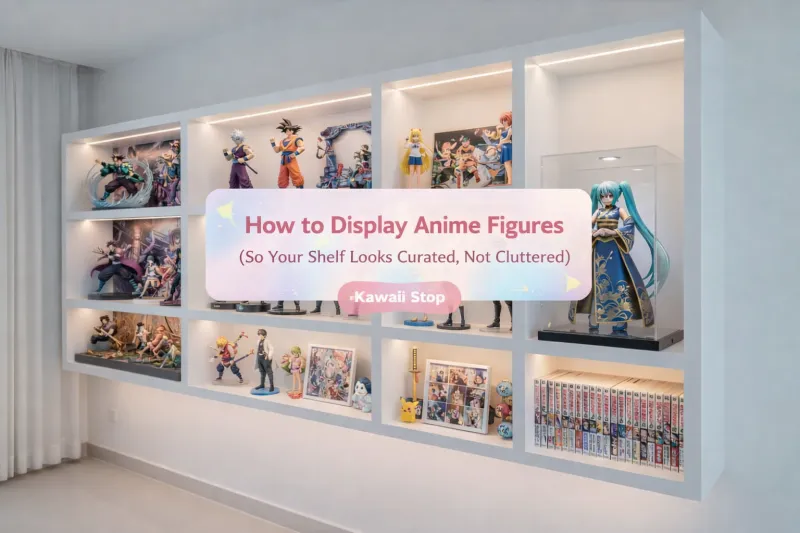
Photo: anime figure collection display shelf close up, via kawaiistop.com
Ask any serious figure collector about their origin story and watch their eyes glaze over with a very specific kind of nostalgia. They won't name a prize figure or a blind box impulse buy. They'll name the one. The scale figure. The pre-order placed at 2 a.m. The $280, $320, sometimes $400 order that sat in their PayPal history like a scar.
Collectors call it different things — the gateway splurge, the point of no return, the shelf cry. That last one is my favorite, because it captures the absurdity perfectly: an adult human, standing in front of a cardboard box, getting genuinely misty-eyed over painted PVC. I've been there. So has basically everyone who's been in this hobby longer than a year.
The Math That Stops Making Sense (And Why That's Fine)
Here's the thing nobody tells you when you're starting out: the jump from $30 prize figures to a $300 scale isn't really about the figure. It's about what the purchase says about you.
Megan, a 29-year-old nurse from Columbus, remembers her moment with painful clarity. "It was the Spiritale Tifa. I'd been telling myself for months that I was 'just browsing.' Then the pre-order went live and I put it in my cart before my brain finished the thought. When I hit confirm, I sat there thinking, well, I guess this is who I am now."
That's the psychology in a nutshell. A cheap figure is a purchase. An expensive one is a declaration. You're telling yourself — and your partner, your roommate, your bank statement — that this character matters enough to justify a car payment's worth of plastic and paint.
And honestly? There's something kind of beautiful about that. We spend money on concerts, on sneakers, on dinners we forget in a week. A great scale figure is a sculpture of something you love, engineered by artists who genuinely care about a 4mm ribbon or the gradient on a sleeve. Compared to a lot of American consumer habits, the shelf cry is a remarkably honest splurge.
The Justification Olympics
Once the order is placed, the mental gymnastics begin. Every collector I spoke to had a personal accounting system, and none of them would survive an audit.
- "It's an investment" (it is not; figures appreciate about as reliably as Beanie Babies)
- "I'm saving money by not buying the other five I wanted"
- "Cost per smile over the lifetime of ownership"
- "I cancelled two streaming services, so basically it's free"
Derek, a collector in Austin, has the most disciplined approach I've heard: "I have a literal envelope labeled 'angel fund.' Every month it gets $75. When a grail pre-order drops, the envelope decides. If the envelope says no, the envelope wins." His system is boring, functional, and the exact reason he's never had a single shelf cry moment of regret — only the happy kind.
The Regret Question
Let's address the elephant in the Detolf: does anyone genuinely wish they hadn't?
Rarely — but not never. The regret stories tend to follow a pattern: the purchase was made during a low moment, for a character with no real emotional weight, or under the fear of missing out on a "sold out forever" deadline. FOMO is the real predator in this hobby. Manufacturers know that "pre-order closes soon" hits the American collector brain like a limited-edition drop at Supreme.
The collectors who are happiest long-term all say some version of the same thing: buy the figure of the character you'd defend in an argument, not the one with the best sculpt of the month. Sculpts get re-released. Your love for a character is the only non-renewable resource in this economy.
After the Box Opens
There's a moment — usually about ten seconds after you unbox it — where the doubt evaporates. The paint work catches your light. The face sculpt is somehow better than the promo photos. You position her on the shelf, step back, and feel something dangerously close to pride.
That's the moment the hobby stops being a hobby. Not the purchase. The arrival.
And from that day forward, every figure you own is measured against the first one that made you go broke. Some fall short. A few, every couple of years, live up to it. Those are the ones worth the envelope money.
So if you're standing at the edge right now, cart loaded, finger hovering — welcome. The water's expensive, the community is warm, and somewhere on your future shelf, an angel is waiting for her halo light.